Can IVF help with Recurrent Miscarriage?
Can IVF help with Recurrent Miscarriage? Understanding your options after repeated pregnancy loss
Losing a pregnancy is heartbreaking. When it happens more than once, it can leave you searching for answers and wondering whether there is anything that can improve your chances of carrying a pregnancy to term.
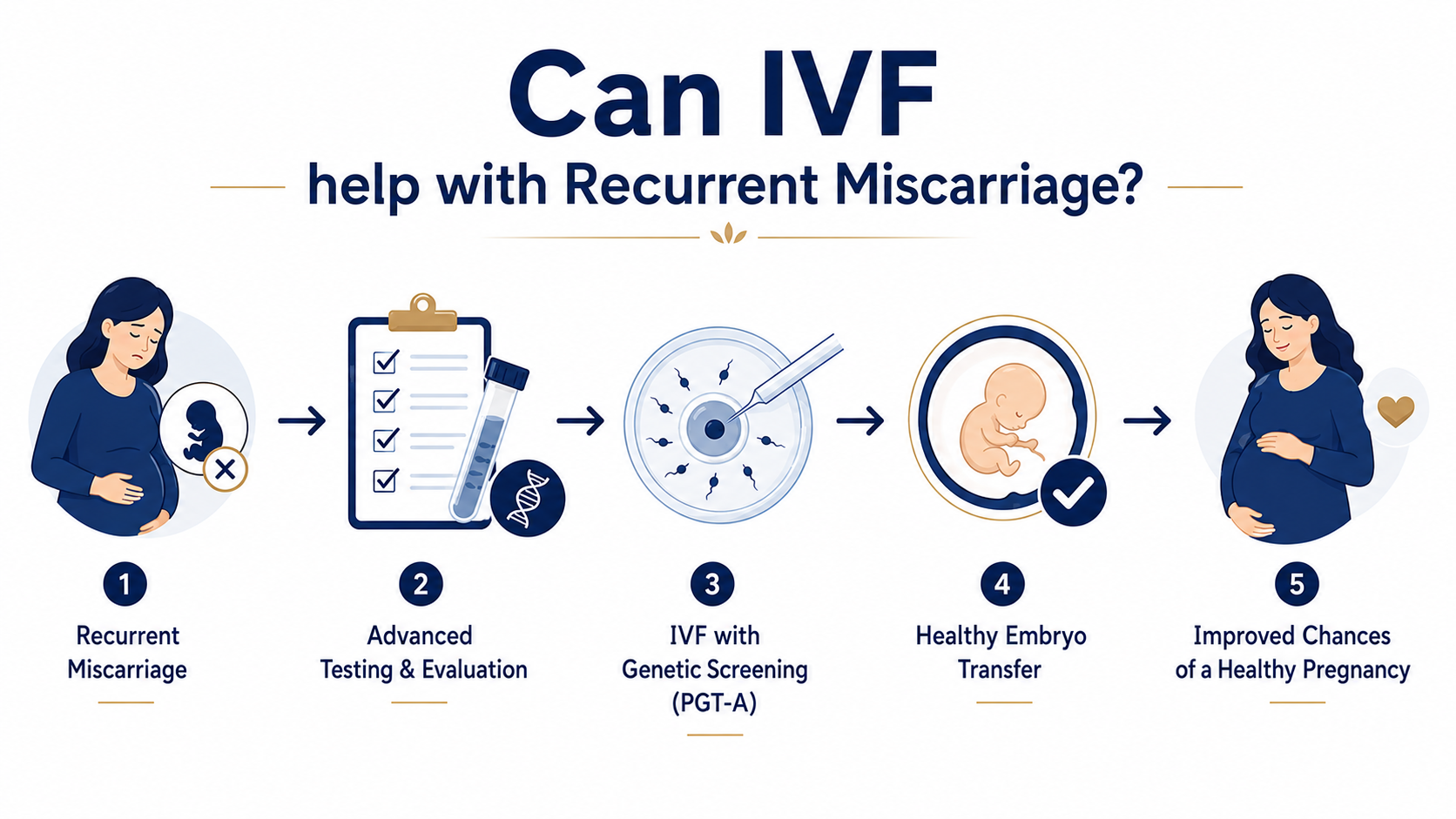
If your miscarriages have occurred very early in pregnancy, particularly before seven weeks, your fertility specialist may investigate whether chromosomal abnormalities in the embryo are contributing to the pregnancy losses. In carefully selected cases, IVF with Preimplantation Genetic Testing for Aneuploidy (PGT-A) may help identify chromosomally normal embryos before transfer.
However, it is important to understand that not all recurrent miscarriages have the same cause, and the question, ‘’Can IVF help with recurrent miscarriage?’’ needs to be understood.
With more than 27 years of experience in Assisted Reproductive Technology (ART), Dr. Gautam Allahbadia has helped thousands of couples overcome complex fertility challenges. Having contributed to the birth of over 10,000 IVF babies across five continents, he combines decades of clinical expertise with advanced reproductive technologies to create individualized treatment plans for every patient. At Allahbadia IVF, every case of recurrent pregnancy loss is carefully investigated before recommending the most appropriate fertility treatment.
In this article, you’ll understand why some women experience repeated very early miscarriages, how chromosomal abnormalities may contribute to these losses, and when IVF with PGT-A may be considered. We’ll also explain who may benefit from this approach, why it is not suitable for every case of recurrent pregnancy loss, and when it is time to consult a fertility specialist.
What is Recurrent Pregnancy Loss?
Recurrent pregnancy loss refers to two or more pregnancy losses. While repeated miscarriages can understandably be grouped together, they are not all caused by the same underlying problem.
The timing of pregnancy loss often provides important clues.
Very early miscarriages, especially those occurring before approximately seven weeks of pregnancy, are commonly associated with chromosomal abnormalities in the embryo. In contrast, miscarriages that occur later in the first trimester or during the second trimester may result from completely different medical conditions, including uterine abnormalities, cervical insufficiency, placental disorders, hormonal problems, infections, or autoimmune diseases.
For this reason, identifying when the miscarriages occurred is an important part of planning the right treatment.
Why do very Early Miscarriages happen?
One of the most common reasons for a pregnancy ending very early is that the embryo develops with an abnormal number of chromosomes.
Normally, an embryo receives 23 chromosomes from the egg and 23 from the sperm, giving a total of 46 chromosomes. Occasionally, an error occurs during fertilization or early cell division, resulting in an embryo with missing or extra chromosomes. These embryos often stop developing naturally, leading to a miscarriage in the earliest weeks of pregnancy.
These chromosomal abnormalities usually happen by chance and become more common as maternal age increases because egg quality naturally declines over time.
It is important to remember that chromosomal abnormalities are primarily linked to very early pregnancy losses. They do not explain every miscarriage, particularly those occurring later in pregnancy.
When should you see a fertility specialist?
Although a single miscarriage is unfortunately common, repeated pregnancy losses deserve a thorough medical evaluation.
A fertility specialist may recommend IVF for recurrent miscarriage if you have experienced:
- Two or more very early miscarriages
- Pregnancy losses with no obvious explanation
- Repeated IVF failures alongside early pregnancy loss
- A family history of inherited genetic disorders
- Difficulty conceiving in addition to recurrent miscarriage
Rather than immediately recommending IVF after multiple miscarriage, the first step is always identifying the underlying cause of the pregnancy losses.
Investigating the cause before choosing treatment
Every patient deserves an individualized evaluation before deciding on fertility treatment.
Your fertility specialist may recommend one or more of the following investigations:
Investigation | Why it is performed |
Karyotype testing | Checks whether either partner carries a chromosomal rearrangement. |
Hormone evaluation | Identifies thyroid disease or hormonal imbalance that may affect pregnancy. |
Uterine assessment | Detects fibroids, polyps, uterine septum, or structural abnormalities. |
3D or 4D transvaginal ultrasound | Provides a detailed assessment of the uterus and reproductive organs. |
Blood tests | Evaluates autoimmune disorders or clotting conditions when clinically indicated. |
Previous pregnancy tissue analysis | Helps determine whether earlier miscarriages were associated with chromosomal abnormalities. |
At Allahbadia IVF, advanced fertility investigations help determine whether chromosomal abnormalities are likely to be contributing to repeated very early pregnancy losses, allowing treatment recommendations to be tailored to each patient’s circumstances.
Can IVF help after Recurrent Very Early Miscarriages?
The answer for fertility treatment for recurrent pregnancy loss depends on why the miscarriages are occurring.
IVF is not a universal treatment for recurrent pregnancy loss. However, in carefully selected patients whose repeated very early miscarriages are thought to be caused by embryo chromosomal abnormalities, IVF combined with Preimplantation Genetic Testing for Aneuploidy (PGT-A) may offer an additional option.
Unlike natural conception, IVF allows embryos to develop in the laboratory before transfer. This creates an opportunity to perform genetic testing on embryos and identify those with a normal chromosome number before implantation.
The aim is not to prevent every miscarriage, but to reduce the likelihood of transferring embryos affected by chromosomal abnormalities in patients for whom this has been identified as a likely cause of repeated very early pregnancy loss.
Recurrent pregnancy loss and IVF- How does IVF with PGT-A work?
For some couples who have experienced recurrent very early miscarriages, the fertility specialist may recommend IVF with PGT-A.
During IVF, eggs are collected and fertilized with sperm in a specialized laboratory. The resulting embryos are allowed to develop for several days before a small number of cells are safely biopsied for genetic analysis.
PGT-A examines the chromosome number within each embryo. This helps identify embryos with the normal number of chromosomes that may be suitable for transfer.
It is important to understand that PGT-A is a screening tool rather than a treatment. Its role is to assist embryo selection in carefully selected patients where chromosomal abnormalities are suspected to be contributing to repeated very early pregnancy loss.
When might IVF with PGT-A be considered?
Not every couple with recurrent miscarriage requires IVF.
Your fertility specialist may discuss IVF with PGT-A if:
- You have experienced two or more very early miscarriages, particularly before seven weeks
- Previous pregnancy tissue testing showed chromosomal abnormalities
- One partner carries a balanced chromosomal rearrangement
- Maternal age increases the likelihood of embryo chromosomal abnormalities
- Other fertility factors are also present, making IVF an appropriate treatment
Every recommendation should follow a complete fertility assessment rather than relying on miscarriage history alone.
When IVF with PGT-A may not be the right option
Repeated pregnancy loss can occur for many reasons beyond embryo genetics.
If pregnancy losses happen later in pregnancy, your fertility specialist may investigate conditions such as:
- Uterine abnormalities
- Cervical insufficiency
- Hormonal disorders
- Thyroid disease
- Autoimmune conditions
- Blood clotting disorders
- Placental abnormalities
- Certain infections
In these situations, treatment is directed toward the underlying medical condition rather than embryo genetic testing.
This is why an individualized evaluation remains the cornerstone of successful recurrent miscarriage treatment.
Can IVF prevent Miscarriage?
No.
A common misconception is that IVF guarantees a successful pregnancy or completely prevents miscarriage.
In reality, IVF cannot prevent every miscarriage.
For carefully selected patients whose repeated very early miscarriages are linked to embryo chromosomal abnormalities, IVF success after recurrent miscarriage with PGT-A may reduce the likelihood of transferring embryos with abnormal chromosome numbers.
However, it cannot prevent miscarriages caused by uterine conditions, hormonal disorders, infections, autoimmune diseases, placental complications, or other medical factors.
The goal is always to choose the treatment that best matches the underlying cause.
IVF with PGT-A at a glance
Situation | Is IVF with PGT-A usually considered? |
Two or more very early miscarriages with suspected chromosomal abnormalities | Yes, after specialist evaluation |
Known parental chromosomal rearrangement | May be recommended |
Advanced maternal age with repeated early losses | May be appropriate |
Second-trimester miscarriage | Usually requires a different evaluation |
Cervical insufficiency | No, treatment focuses on the cervix |
Uterine abnormalities | Usually corrected before pregnancy when appropriate |
Autoimmune or clotting disorders | Managed with medical treatment rather than PGT-A alone |
Why choose Dr. Gautam Allahbadia?
Dr. Gautam Allahbadia is internationally recognized for his contributions to reproductive medicine and assisted reproduction.
His experience includes:
- More than 27 years in reproductive medicine and IVF
- Over 10,000 IVF babies delivered across five continents
- Pioneer of Minimal Stimulation IVF (IVF Lite) in India and the Middle East
- International authority on ultrasound-guided embryo transfer
- Author of more than 40 textbooks, over 150 peer-reviewed publications, and numerous book chapters in reproductive medicine
- Former Vice President of the World Association of Reproductive Medicine (WARM)
- Trainer to more than 400 fertility specialists worldwide
Choosing the right fertility center is about more than technology. It is about receiving the right diagnosis and the right treatment for your individual circumstances.
At Allahbadia IVF, patients benefit from:
- Personalized fertility assessments
- Advanced reproductive genetics when clinically appropriate
- Comprehensive fertility investigations
- 3D and 4D transvaginal ultrasound
- Modern IVF and IVF Lite treatment options
- Compassionate support throughout the fertility journey
- International expertise combined with individualized patient care
Every treatment recommendation is made after understanding your medical history, fertility goals, and the possible causes of pregnancy loss.
Every pregnancy loss deserves the right diagnosis
Experiencing repeated pregnancy loss can be emotionally overwhelming, but it is important to remember that not all miscarriages have the same cause.
For couples experiencing recurrent very early miscarriages, identifying whether chromosomal abnormalities are contributing to pregnancy loss is an important first step. When appropriate, IVF with PGT-A may help improve embryo selection by identifying chromosomally normal embryos for transfer.
Equally important is recognizing that later pregnancy losses often require a completely different diagnostic approach and treatment plan. A thorough fertility evaluation ensures that every patient receives care tailored to their unique situation.
If you have experienced repeated very early miscarriages or are looking for answers after recurrent pregnancy loss, schedule a consultation with Dr. Gautam Allahbadia. A comprehensive fertility assessment can help identify the underlying cause and determine whether IVF with PGT-A or another treatment option is appropriate for your individual circumstances.