
The future of IVF: AI technology changing fertility treatment
Millions of couples struggle with pregnancy and the journey to parenthood is not easy, particularly when experiencing the challenges of infertility. In vitro fertilization (IVF) has provided hope to a great number of people by combining an egg and sperm in a lab to form an embryo. Today, new technology used in fertility clinics has been coming to the rescue, making the process even more accurate.
Today, AI technology changing fertility treatment by converting standard, uniform protocols into highly data-driven, adaptive clinical practices. In our practice, integrating digital tools allows embryologists and clinicians to evaluate complex physiological patterns, offering clearer insights for patients navigating reproductive care.
Some of the most important reproductive medicine challenges that can be tackled with the incorporation of AI into IVF are explained here. AI can offer doctors relevant, unbiased assistance by examining a lot of information, including past diagnostics, hormonal levels, and cell development patterns.
This transition minimizes the need for manual monitoring, resulting in smoother workflows and more predictable timelines. Couples undergoing treatment will have realistic expectations for how technology can help clinical treatment to reduce the number of cycles needed, as well as what to anticipate when the treatment carries the potential for side effects.
When couples are seeking treatment, it is important that they have realistic expectations of how technology will augment clinical practice to decrease the number of cycles required and what they may expect when the treatment has the potential for side effects.
Understanding the mechanisms of AI in IVF
Today’s laboratories rely on automated digital systems to monitor data that is invisible to humans. A normal IVF cycle has a number of stages that must be closely monitored, such as examining reproductive cells at the beginning and observing the embryo development as it grows. Each step is more exact when using digital tools.
- Semen analysis: Computer-assisted systems assess sperm motility, shape and concentration, but without operator-dependent variations. This ensures that the diagnostic report will be uniform and allows specialists to select the best preparatory methods.
- Predicting clinical outcomes: More sophisticated algorithms use preliminary diagnostics, baseline hormone levels and genetic testing to make a prognosis about the chance of success of a given protocol. Such information can guide the specialists to make a change in strategy at a very early stage, before the cycle is finished.
- Hormone monitoring and adjustments: The levels of hormones change rapidly while ovarian stimulation is in progress. These adjustments are tracked digitally, and the clinician can fine-tune the dose of drugs during the procedure to get the most eggs. The role of automatically selecting embryos. The function of automatic embryo selection.
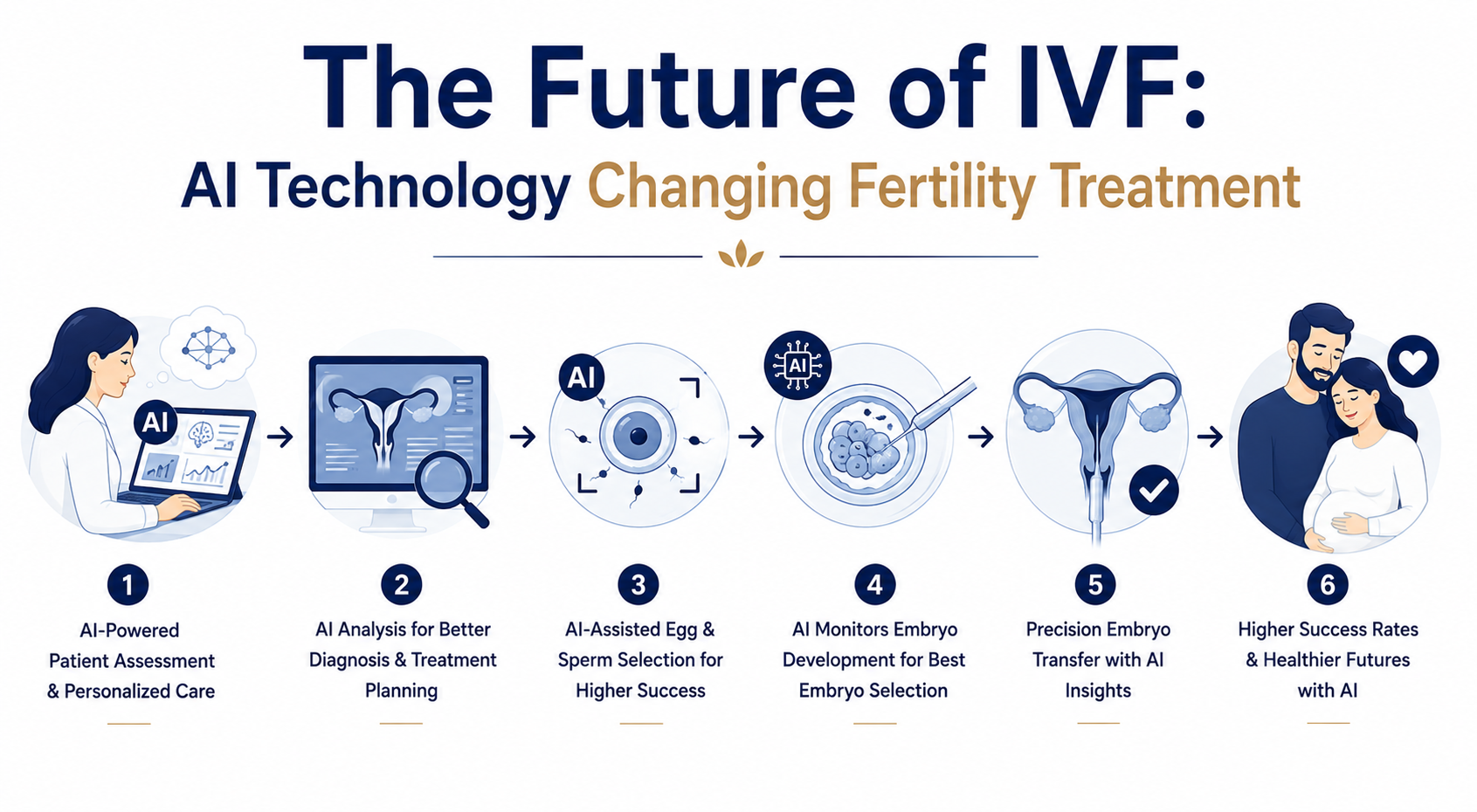
The role of automated embryo selection
Choosing the most viable embryo for transfer is a critical step in the IVF process. Traditionally, embryologists evaluate embryos at specific intervals under a microscope, assigning visual grades based on shape and cell expansion. This is an effective approach, but it can only give snapshots of development.
Time-lapse imaging combined with machine learning alters this approach. In automated systems, an embryo is positioned within the incubator and development is continuously monitored by the automated system, which records development without bringing the embryo to any external environmental changes.
Thousands of data points are analyzed in the system, and micro patterns are detected that are characteristic of high implantation potential. It also gives a non-invasive estimation of genetic viability that helps enable clinicians to make objective decisions on which single embryo to transfer.
Can AI improve IVF success rates?
A central question for many individuals exploring advanced care is: Can AI improve IVF success rates? There is a positive trend seen in the objective data. The technology is able to select the most viable embryos and optimize the transfer window, which helps minimize failed cycles and miscarriages.
Clinical Parameter | Standard Process | AI-Enhanced Process |
Embryo evaluation | Periodic manual microscopic grading | Continuous non-invasive time-lapse analysis |
Ovarian stimulation | Static protocol adjustments | Real-time hormone data processing |
Cycle efficiency | Often requires multiple attempts | Fewer cycles are needed to achieve pregnancy |
Not only does it help to make the process more efficient, but it can also save on costs. It also helps to increase the accuracy in every step, so that patients can finish the treatment in fewer tries, reducing the overall cost of the treatment.
The landscape of the future of fertility treatment with AI
Machine learning is going to change practice continuously in reproductive medicine. AI in the future will allow for the complete customization of fertility treatments, based on couples’ individual biology.
Looking ahead, the future of fertility treatment with AI IVF treatment planning promises to optimize protocols prior to stimulation, thus reducing typical clinical risks. Advanced fertility clinic technology will continue to drive the laboratory process to become more efficient and streamlined as these tools become more widely available and accessible, ensuring that high-quality reproductive care is available, no matter where in the world they are located.
Take the next step with Allahbadia IVF
Getting fertility care means balancing advanced science with personal support. At Allahbadia IVF, we use our years of experience and the latest technology to help you at every step of your journey.
If you want to learn more about how AI is changing IVF treatment or wish to discuss a personalized approach tailored to your unique needs, our team is here to help. Contact Allahbadia IVF today to schedule a comprehensive consultation with our specialists.

FAQ
Traditional planning that is dependent upon historical data averages and standardized clinical guidelines. In contrast, AI IVF treatment planning uses specific algorithms to analyze an individual’s unique genetic indicators, medical background, and current hormonal shifts, leading to a personalized treatment plan based on their unique physiology.
Yes, the technology is 100% safe. Advanced image analysis and time-lapse photography are used in the tools. Evaluation process is performed in protected incubators during evaluation time to minimize external influencing and manipulation of embryos.
AI helps optimize success rates across various demographics by identifying viable cellular patterns that might be missed during manual inspections. While it cannot alter baseline egg quality, it ensures that every viable option is accurately identified and utilized effectively.
Advanced technology makes diagnosis and embryo selection more accurate which helps to reduce failed IVF cycles. Fewer pregnancies will translate to fewer costs for repeated medicines and procedures.