How sleep quality impacts fertility and IVF success
Trying to conceive often brings attention to nutrition, exercise, supplements, and medical treatment. One important factor, however, is frequently overlooked, which is sleep. Good-quality sleep is not simply about feeling refreshed the next morning. It plays a central role in hormone regulation, egg and sperm health, metabolism, immune function, and emotional well-being, all of which influence reproductive health.
If you are planning a pregnancy naturally or preparing for IVF, your nightly sleep routine may have a greater effect than you realise. Research continues to show that sleep quality and fertility are closely connected, making healthy sleep an important part of every fertility plan.
Sleep is more than just rest. It plays an important role in your reproductive health and can influence your fertility journey. In this article, you’ll learn how sleep quality impacts fertility, whether poor sleep affects fertility and IVF outcomes, the connection between sleep quality and fertility, and the best sleep habits for fertility. You’ll also understand IVF success factors, whether sleep quality affects egg quality, how many hours of sleep support reproductive health, and simple lifestyle changes that may improve your chances of conception.
Your fertility journey deserves the right guidance
Sleep is only one part of successful fertility care. At Allahbadia IVF, Dr Gautam Allahbadia combines over three decades of experience with evidence-based fertility treatment, advanced embryology, and personalized care to help couples maximise their chances of success. Every treatment plan is designed around your individual medical history, lifestyle, and reproductive goals.
Why does sleep matter for Fertility?
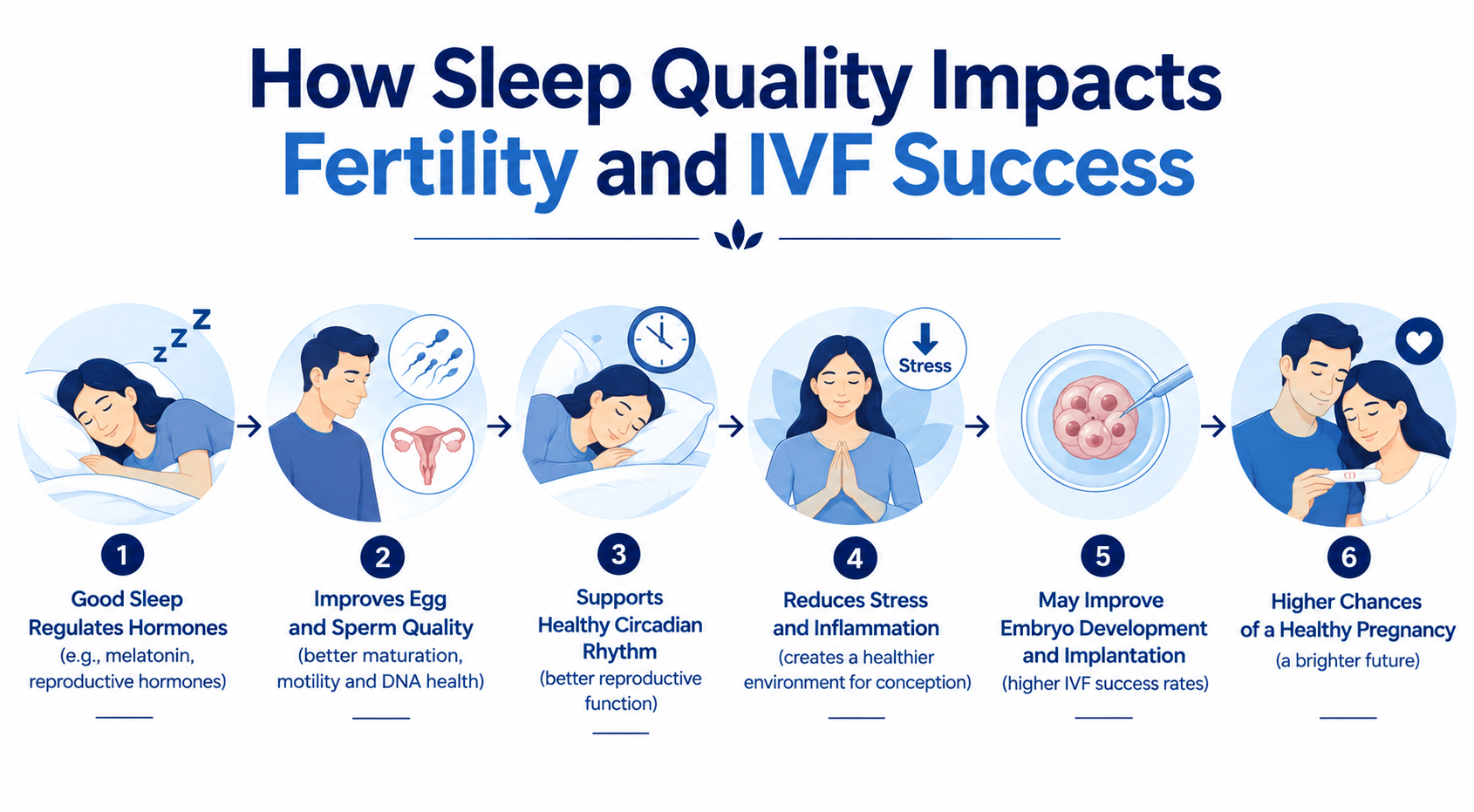
Your body carries out many important reproductive processes while you sleep. During the night, hormone production, cellular repair, and immune regulation work together to prepare the body for conception.
Poor sleep does much more than leave you tired. It can disturb hormones responsible for ovulation, sperm production, embryo implantation, and early pregnancy.
Whether you are trying naturally or undergoing fertility treatment, healthy sleep supports:
- Ovulation
- Menstrual cycles
- Egg development
- Sperm production
- Hormonal balance
- Stress hormones
- Metabolism
- Improved overall reproductive health
These factors are even more crucial when the couple starts IVF treatment, since when the body’s hormonal levels fluctuate during treatment, it is not so favorable.
A Quick Fact A large review published in Sleep Medicine Reviews found that sleep disturbances may affect reproductive hormones, menstrual function, fertility, and pregnancy outcomes in women. |
How sleep quality impacts fertility
Many people ask, “Can poor sleep affect fertility?” The answer appears to be yes.
Researchers now understand that the body’s internal clock, known as the circadian rhythm, helps regulate several hormones involved in reproduction. Irregular sleep, frequent night waking, shift work, or chronic sleep deprivation can disrupt this natural rhythm.
When sleep suffers, several changes may occur:
Healthy Sleep | Poor Sleep |
Stable reproductive hormones | Hormonal fluctuations |
Regular ovulation | Irregular ovulation |
Healthy egg development | Increased oxidative stress |
Better sperm production | Lower sperm quality |
Balanced cortisol levels | Elevated stress hormones |
Better metabolic health | Insulin resistance and inflammation |
Although sleep alone does not determine fertility, it forms one of several lifestyle factors that influence reproductive potential.
Sleep, hormones and reproductive health
Hormones constantly communicate with the brain and reproductive organs. Many of these signals are strongest during sleep.
A lack of quality sleep may interfere with:
Luteinizing Hormone (LH)
LH triggers ovulation. If sleep is disrupted, hormone release can be changed and this can impact on ovulation.
Follicle-Stimulating Hormone (FSH)
FSH helps the follicles in the ovary to grow, containing the developing eggs. The proper production of hormones is important for the proper functioning of the ovaries.
Estrogen and Progesterone
These hormones regulate the menstrual cycle and prepare the uterus for implantation.
Cortisol
Poor sleep increases cortisol, the body’s primary stress hormone. Persistently high cortisol levels may interfere with reproductive hormones and reduce fertility.
Melatonin
Often called the sleep hormone, melatonin also acts as a powerful antioxidant. Beyond helping regulate sleep, it protects reproductive cells from oxidative damage.
Does sleep quality affect egg quality?
One of the most common questions patients ask is, “Does sleep quality affect egg quality?“
Current evidence suggests that healthy sleep may support better egg development by reducing oxidative stress inside the ovaries.
Every month, developing eggs are exposed to normal metabolic processes that generate free radicals. Antioxidants help neutralize this damage.
Melatonin is one of the body’s natural antioxidants. It is produced mainly during darkness and has been found in the fluid surrounding developing eggs inside ovarian follicles.
Researchers believe that healthy melatonin levels may help protect eggs during maturation, although many factors, including age, ovarian reserve, genetics, and overall health, continue to influence egg quality.
For women undergoing IVF, maintaining consistent sleep may help create a healthier environment for ovarian stimulation and egg retrieval.
Can lack of sleep reduce chances of pregnancy?
Another frequently asked question is, “Can lack of sleep reduce chances of pregnancy?” There may be multiple mechanisms by which sleep loss impacts fertility, rather than one.
These include:
- Increased inflammation
- Hormonal imbalance
- Poor glucose regulation
- Higher stress levels
- Reduced immune regulation
- Irregular menstrual cycles
- Delayed ovulation
For women seeking to conceive naturally, these changes can make it less likely for them to get pregnant in the future.
Good sleep can help a couple’s body respond to treatment when they are undergoing assisted reproduction.
Does sleep impact IVF success rates?
Patients often wonder, “Does sleep impact IVF success rates?”
While IVF success depends on many clinical and biological factors, emerging research suggests that sleep quality deserves attention.
Women receiving fertility treatment frequently experience anxiety, medication-related hormonal changes, and emotional stress, all of which may interfere with sleep.
Studies have reported associations between poor sleep and:
- Reduced egg yield
- Lower egg quality
- Fewer high-quality embryos
- Reduced implantation potential
Sleep should therefore be viewed as one of several IVF success factors, alongside maternal age, embryo quality, laboratory standards, uterine health, and personalized treatment protocols.
Improving sleep cannot guarantee pregnancy, but it represents a simple lifestyle change that may support overall reproductive health throughout the IVF process.
How many hours of sleep are best for fertility?
There is a question from many couples that asks, “How many hours of sleep are the best for fertility?” Most fertility experts recommend about 7 – 9 hours of deep sleep each night. Interestingly, both insufficient and excessive sleep have been linked to poor reproductive outcomes.
Quality is as important as quantity; consistency is key. Maintaining a consistent bedtime and morning schedule helps to keep your body’s biological clock in sync, thereby affecting the production of hormones, ovulation and sperm development.
Try to establish a routine so your body can recover each night. Small lifestyle changes can have a big impact on your fertility. There are a few lifestyle changes that can make a difference regarding fertility.
It isn’t necessary to overhaul your lifestyle to create healthy sleep habits for fertility. There are a number of easy changes you can make to enhance sleep quality and reproductive health.
Get a regular sleep plan and stick to it
Keep to a regular bedtime routine, including weekends. Your body has a natural rhythm of sleep and wakefulness that can be disrupted by a lack of routine. Having a predictable routine will help your body to keep its sleep-wake cycle in line.
Limit screen time before going to bed
Blue light from mobile phones, tablets and laptops has an inhibitory effect on the production of melatonin. Avoid using electronic devices for one hour prior to sleep so that your brain can switch to sleep mode naturally.
Make your bedroom as cozy as possible
A dark, quiet and cool bedroom can promote deep sleep. Blackout curtains, soft bedding, and minimizing unnecessary noise are all ways that can help.
Limit caffeine late in the day
Coffee, tea, energy drinks, and caffeinated soft drinks may remain in your system for several hours. Avoiding caffeine during the afternoon and evening can make it easier to fall asleep.
Stay physically active
Regular exercise supports hormone balance, reduces stress, and improves sleep quality. However, avoid vigorous workouts close to bedtime, as they may make it harder to fall asleep.
Manage emotional stress
Fertility treatment can be emotionally demanding. Relaxation techniques such as deep breathing, meditation, reading, gentle stretching, or mindfulness before bed may help calm the mind.
Can poor sleep affect male fertility?
Discussions around fertility often focus on women, but sleep is equally important for men.
Several studies suggest that poor sleep may contribute to:
- Reduced testosterone production
- Lower sperm count
- Reduced sperm motility
- Increased DNA damage within sperm
- Reduced semen quality
Since most testosterone production occurs during sleep, ongoing sleep deprivation may interfere with healthy sperm production. Improving sleep, therefore, benefits both partners when planning a pregnancy.
Melatonin and fertility: More than a sleep hormone
Melatonin is widely recognized for regulating the body’s sleep cycle, but it also plays an important role in reproductive health.
As a natural antioxidant, melatonin helps protect cells from oxidative stress. Researchers have found melatonin within ovarian follicles, where it may help protect developing eggs from cellular damage.
In a few clinical trials, melatonin supplementation has been found to improve embryo quality and fertilization rate in specific patients undergoing IVF treatment. But research is still in progress and supplements are not for all people.
For this reason, patients should never begin melatonin supplements without consulting their fertility specialist.
Foods that naturally support better sleep
Although no food can replace healthy sleep habits, certain foods naturally contain melatonin or nutrients that support sleep regulation.
These include:
- Cherries
- Bananas
- Oats
- Walnuts
- Tomatoes
- Barley
- Brown rice
- Kiwi fruit
- Milk and yoghurt
A balanced diet rich in fruits, vegetables, whole grains, healthy fats, and lean proteins also supports hormone production and overall fertility.
Lifestyle factors that work alongside good sleep
Healthy sleep delivers the greatest benefit when combined with other positive lifestyle habits.
Consider the following:
Lifestyle Habit | Potential Benefit for Fertility |
7-9 hours of quality sleep | Supports hormone balance |
Healthy body weight | Improves ovulation and sperm health |
Regular exercise | Supports metabolism and circulation |
Balanced nutrition | Provides nutrients for egg and sperm development |
Stress management | Helps regulate cortisol levels |
Limiting smoking and alcohol | Protects reproductive health |
Following medical advice | Optimizes IVF treatment outcomes |
When combined, these habits create an environment that supports natural conception as well as assisted reproductive treatments.
Why choose Allahbadia IVF?
Choosing the right fertility clinic involves more than looking at treatment options. It is about finding a team that combines experience, advanced technology, and compassionate care.
At Allahbadia IVF, patients benefit from:
- Over 30 years of experience in reproductive medicine led by Dr Gautam Allahbadia
- Personalized fertility treatment plans tailored to each patient
- Advanced embryology laboratory and evidence-based IVF protocols
- Expertise in modern fertility techniques, including Single Embryo Transfer (SET) and Frozen Embryo Transfer (FET)
- State-of-the-art technology, including advanced 3D and 4D ultrasound imaging
- Prompt patient support and communication throughout treatment
- A patient-centered approach that addresses both medical and emotional needs
- Internationally recognized expertise combined with compassionate care
Prioritize better sleep to support your fertility journey
If you have been wondering “Can poor sleep affect fertility?” or “Does sleep impact IVF success rates?“, growing scientific evidence suggests that healthy sleep deserves attention alongside nutrition, exercise, and medical care.
Whether you are planning your pregnancy or preparing for IVF, investing in better sleep is an investment in your overall health and reproductive wellbeing. At Allahbadia IVF, Dr Gautam Allahbadia and his experienced team combine decades of expertise with advanced reproductive technology and personalized care to help couples make informed decisions at every stage of treatment.
Book a consultation today and discover how expert fertility care, combined with healthy lifestyle choices, can support your journey towards parenthood.