When Should Men Get Fertility Tests?
When should men get Fertility Tests? A complete guide for couples planning parenthood
Starting a family is an exciting milestone, but when pregnancy doesn’t happen as expected, it is natural to have questions. While many people assume fertility concerns begin with women, male reproductive health plays an equally important role. In fact, male factors contribute to nearly half of all infertility cases, making early evaluation an essential step for couples trying to conceive.
Most common question that comes to mind is, ‘’When should men get fertility tests?’’.
A fertility test for men is simple, non-invasive, and can identify issues that may otherwise remain unnoticed. Getting tested early can save valuable time, reduce unnecessary stress, and help couples choose the most suitable fertility treatment.
Allahbadia IVF takes a holistic view of fertility assessment as a journey of the couple. The clinic is managed by two fertility specialists, who conduct in-depth evaluations of men’s fertility and provide customized treatment plans. The clinic also provides cutting-edge IVF and ICSI solutions to enhance the likelihood of an IVF pregnancy. Each couple will receive evidence-based recommendations specific to their fertility needs.
In this guide, you’ll learn when men should get fertility tests, the common causes of male infertility, the warning signs to watch for, how male infertility is diagnosed, lifestyle factors affecting sperm quality, available fertility treatment options for men, when to see a fertility specialist and when advanced treatments such as IVF or ICSI may be recommended.
What is Male Fertility Testing?
Male infertility testing is a series of tests to determine if sperm is healthy, if hormones are balanced, and if the reproductive system is working properly. These tests can help assess whether a man’s sperm is in good condition for use in natural conception or if medical treatment and/or assisted reproductive medicine is needed.
Many men have no obvious signs of male infertility, which is why testing should never be delayed simply because there are no symptoms.
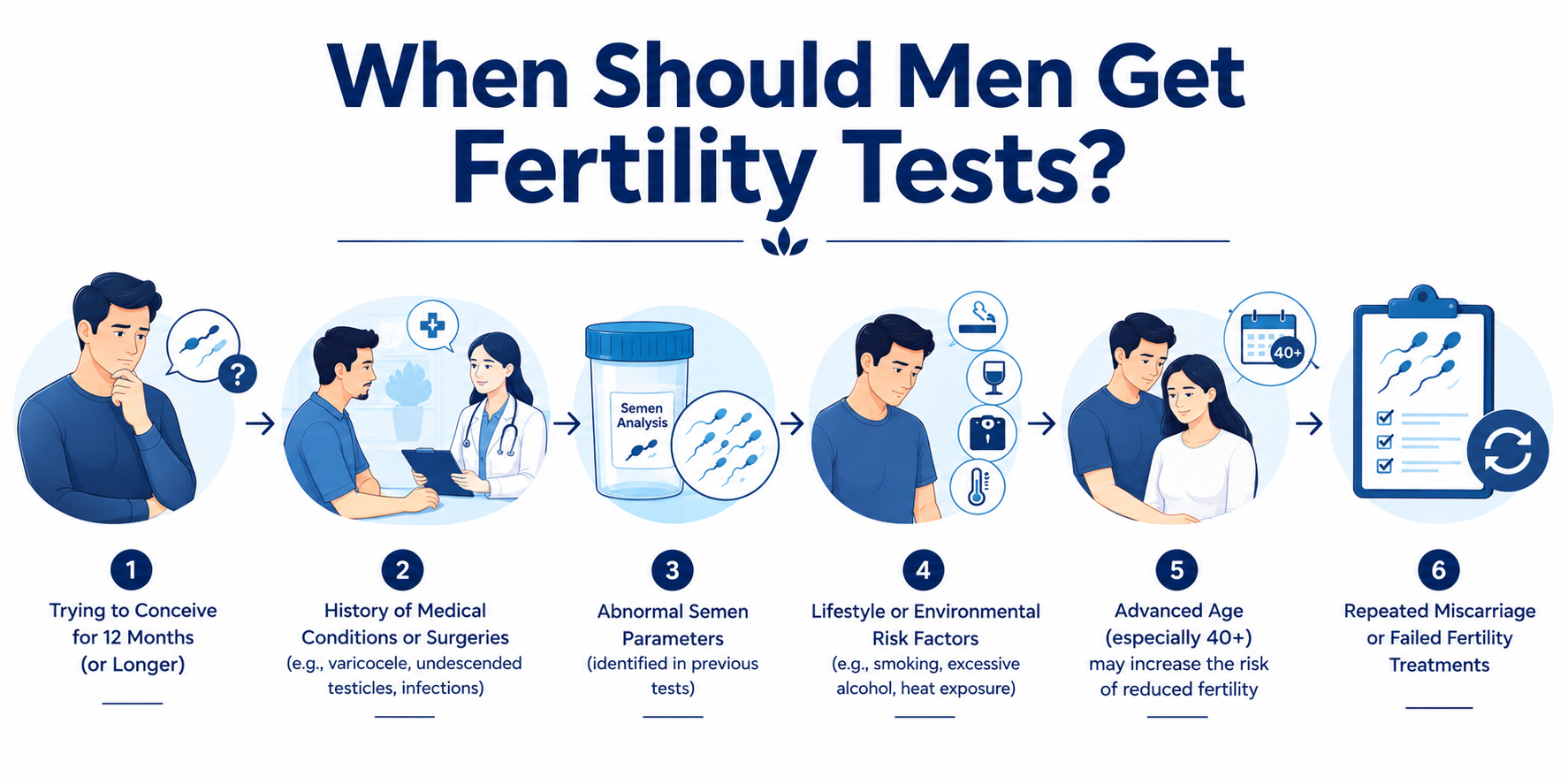
When should men get fertility tests?
Many couples wait too long before seeking medical advice. Early evaluation often identifies treatable problems before they become larger obstacles.
You should consider a fertility test for men if:
- You have been trying to conceive for 12 months without success (or after 6 months if your partner is over 35).
- You have experienced recurrent miscarriages with your partner.
- You have a history of undescended testes, testicular injury, or surgery.
- You have undergone chemotherapy or radiation.
- You have previously had an abnormal semen analysis.
- You are planning male fertility tests before IVF or male fertility tests before ICSI.
- You have known hormonal disorders or genetic conditions.
- You have been diagnosed with varicocele or recurrent genital infections.
Early testing allows fertility specialists to recommend timely treatment rather than relying on months of uncertainty.
Common causes of Male Infertility
Several medical and lifestyle factors can affect sperm production and function.
Medical Causes | Lifestyle Causes |
Varicocele | Smoking |
Hormonal imbalance | Excessive alcohol intake |
Undescended testicles | Obesity |
Genetic disorders | Chronic stress |
Previous infections | Poor nutrition |
Blockages in the reproductive tract | Heat exposure (hot tubs, laptops on lap) |
Certain medications | Lack of exercise |
Identifying the causes of male infertility early improves the likelihood of successful treatment.
Signs of Male Infertility
Contrary to popular belief, infertility rarely causes noticeable symptoms.
However, some men may experience:
- Difficulty achieving pregnancy despite regular unprotected intercourse
- Pain, swelling, or discomfort around the testicles
- Reduced facial or body hair due to hormonal imbalance
- Problems with ejaculation
- Erectile dysfunction
- Previous history of reproductive disorders
It is important to understand that low sperm count symptoms are often absent. Many men with significantly reduced sperm counts feel completely healthy.
For this reason, fertility specialists recommend testing based on medical history and the duration of trying to conceive rather than waiting for symptoms to appear.
How is Male Infertility diagnosed?
Many couples ask, “How is male infertility diagnosed?“
The evaluation usually begins with a detailed medical history and physical examination, followed by laboratory investigations.
Common diagnostic tests
Test | Purpose |
Semen Analysis | Evaluates sperm count, motility, morphology, and semen volume |
Hormone Testing | Assesses testosterone, FSH, LH, Prolactin, and Thyroid function |
Scrotal Ultrasound | Detects varicocele, structural abnormalities, or obstruction |
Genetic Testing | Recommended for severe sperm abnormalities or azoospermia |
Sperm DNA Fragmentation Test | Evaluates sperm DNA quality, especially before IVF or recurrent pregnancy loss |
A semen analysis remains the cornerstone of male fertility assessment, but additional investigations help uncover problems that routine testing may miss.
Male Fertility Tests before IVF and ICSI
Before beginning assisted reproductive treatment, comprehensive male evaluation is essential.
Male fertility tests before IVF help determine whether conventional IVF offers a reasonable chance of fertilization or whether additional treatment may improve outcomes.
Similarly, male fertility tests before ICSI (Intracytoplasmic Sperm Injection) provide valuable information about sperm quality, DNA integrity, and underlying conditions that may influence embryo development.
Testing beforehand enables fertility specialists to select the most appropriate treatment strategy while avoiding unnecessary delays.
Lifestyle factors affecting sperm quality
Healthy sperm production depends on much more than genetics. Everyday habits can influence sperm count, movement, and DNA quality, making lifestyle an important part of male reproductive health.
Some of the most common lifestyle factors affecting sperm quality include:
- Smoking and tobacco use
- Excessive alcohol consumption
- Being overweight or obese
- Chronic stress and inadequate sleep
- Poor nutrition
- Limited physical activity
- Exposure to pesticides, industrial chemicals, or radiation
- Frequent heat exposure from hot tubs, saunas, or prolonged laptop use on the lap
Since sperm take approximately 70 to 90 days to develop, healthy lifestyle changes may take a few months before improvements appear on repeat testing.
Can men improve fertility naturally?
One of the most frequently asked questions by couples is ‘Can men enhance their fertility naturally?’. There are numerous instances in which the answer is yes. Although some medical conditions need to be treated,
Here are a few practical steps:
- Making better lifestyle choices can make a big difference to the health of sperm
- Maintain a balanced diet with plenty of fruits, vegetables, whole grains, lean proteins and healthy fats
- Keep a healthy weight
- Regular exercise but not over-exercising
- Stop smoking and drugs
- Limit alcohol intake
- Sleep 7-8 hours per night
- Manage stress through meditation, yoga, or other relaxation techniques
- Avoid prolonged exposure to excessive heat around the testicular area
- Take supplements only under the guidance of a fertility specialist
Although lifestyle improvements cannot correct every fertility problem, they often enhance sperm quality and support better reproductive outcomes.
Fertility Treatment options for men
Treatment depends on the underlying diagnosis. After evaluating the test results, your fertility specialist will recommend the most suitable approach.
Diagnosis | Possible Treatment |
Hormonal imbalance | Hormonal medications or medical management |
Varicocele | Varicocele repair surgery |
Infection | Antibiotic treatment |
Ejaculatory disorders | Medical or assisted sperm retrieval |
Low sperm count | Lifestyle modification, medication, or assisted reproduction |
Severe sperm abnormalities | IVF or ICSI with specialized sperm selection |
Obstructive azoospermia | Surgical sperm retrieval with IVF/ICSI |
Today, several fertility treatment options for men can successfully overcome male factor infertility, even in complex cases.
Why choose Allahbadia IVF?
Choosing the right fertility center can make a meaningful difference throughout your parenthood journey.
Why couples choose Allahbadia IVF:
- Gautam Allahbadia has decades of experience in the treatment of both male and female fertility problems
- Fertility assessment of both partners in a single place
- Advanced diagnostics for accurate diagnosis and individual treatment
- Knowledge of IVF, ICSI, fertility preservation and challenging fertility issues
- Treatment plans tailored to each couple’s medical history and their goals for their treatment
- Individualized treatment plans based on each couple’s medical history and reproductive goals
- Modern laboratory infrastructure and evidence-based treatment protocols
- Compassionate counseling and transparent communication throughout every stage of treatment
- A patient-first approach focused on achieving healthy pregnancies with safe, ethical fertility care
Early testing can save valuable time on your fertility journey
Many couples spend months searching for answers when a simple male fertility evaluation could provide valuable direction from the beginning. Since male infertility often develops without obvious symptoms, waiting for warning signs may delay treatment unnecessarily.
Don’t delay testing if you have been trying to conceive and have not succeeded, have known risk factors, or you are getting ready to use assisted reproduction. If you can be diagnosed early, your fertility specialist can help you determine the best course of treatment and help you have the family you have in mind.
From routine fertility check-ups for men to preparing for in-vitro fertilization (IVF) or intra-cytoplasmic sperm injection (ICSI), to providing expert advice on reproductive health matters, the seasoned team at Allahbadia IVF is here to help. Call now for a full fertility evaluation and customized recommendations according to your objectives.